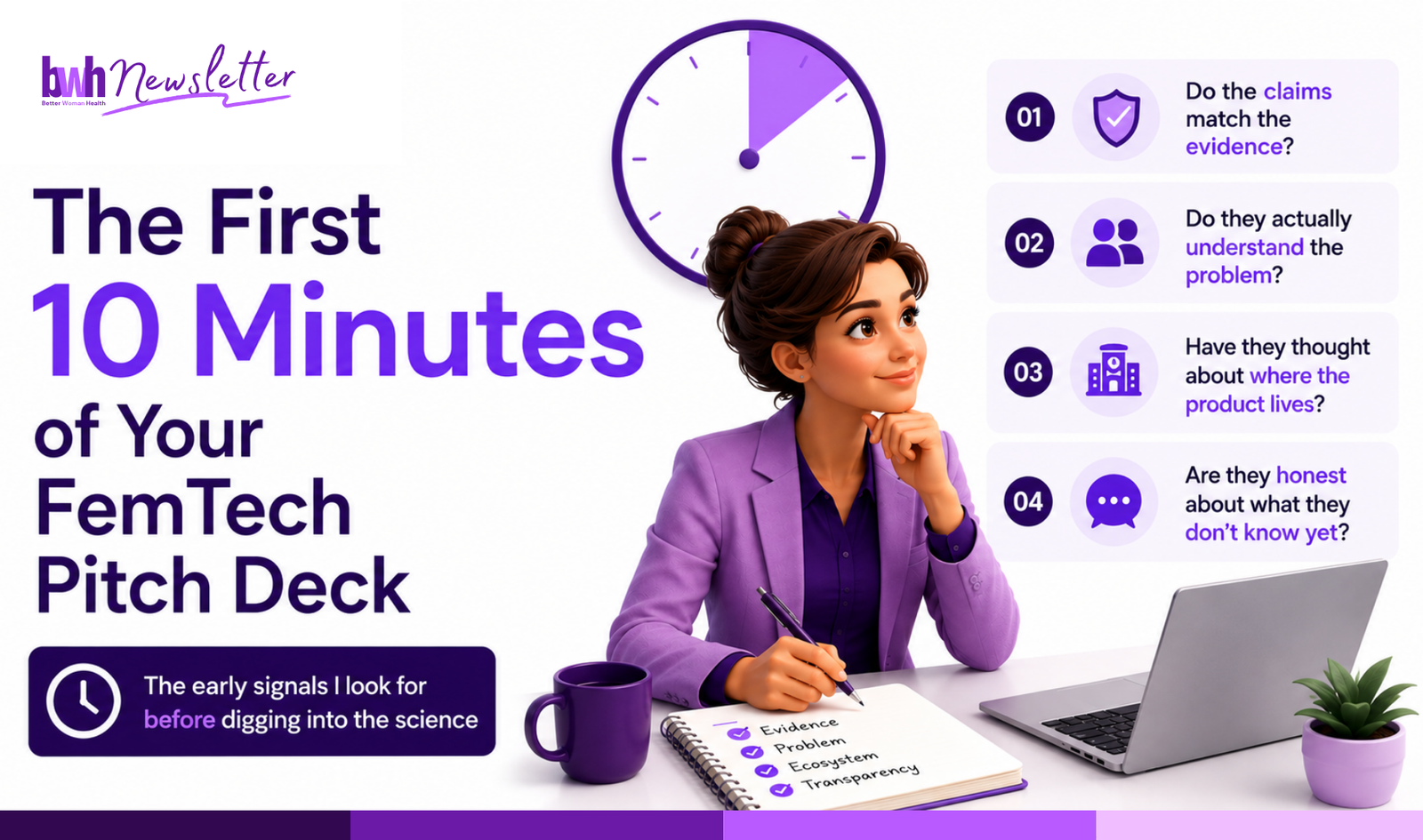
The early signals I look for before digging into the science
After reviewing many FemTech pitch decks, one thing has become consistently clear: you don’t need all sixty slides to spot the biggest credibility risks. Most reveal themselves in the first ten minutes, if you know what to look for.
In that first stretch, I’m not validating the science or fact-checking every citation. I’m doing something simpler: looking for early signals that tell me where the credibility risks might be hiding, so I know where to dig deeper.
These signals are important because credibility problems are much easier and much less expensive to fix before launch than after investors, clinicians, regulators, or patients have already seen the product.
Those first ten minutes don’t give me a verdict.
They give me a map of where the credibility risks are most likely to be, so I know exactly where to spend the next hour.
Do the claims match the evidence?
This is always the first thing I check.
When a founder says, “We reduce maternal mortality” or “We improve hormonal health,” my immediate question is, “What’s that actually based on?”
Sometimes the answer is user satisfaction or engagement metrics.
Those metrics are valuable. They tell me whether people like the product. But they don’t tell me whether the product changed a clinical outcome. People enjoying a product and a product improving health are two very different claims, and pitch decks can easily blur that line.
That doesn’t automatically mean the product is bad. It simply means the claim is stronger than the evidence currently supports.
And it’s far easier to correct that early than after the claim has been shared with investors, clinicians, or users who may begin relying on it.
Do they actually understand the problem?
The second thing I look for is simpler to describe but harder to fake.
Can the founder clearly explain who experiences the problem, why it exists, and why current solutions aren’t enough?
A clear answer tells me the product was built around a real clinical need.
When I have to keep pulling the thread, it’s often a sign that the solution came first and the problem was fitted around it afterward. That tends to produce products that are technically impressive but clinically disconnected.
Have they thought about where the product actually lives?
Healthcare doesn’t stop at the patient and the app.
A woman using a health product doesn’t exist in isolation. She interacts with clinicians, hospitals, pharmacies, insurers, and regulators. A product that focuses only on the patient’s phone screen is missing half the picture.
I’m looking for evidence that the founder has thought about that journey. Where does a referral happen? Who follows up if something goes wrong? Would a clinician have a reason to trust and recommend this product?
This matters at launch and when expanding into new markets. Healthcare systems aren’t interchangeable. A product that works in one country’s regulatory environment, payment model, or care pathway won’t automatically fit another. That’s where I’ve seen many good ideas quietly fall apart.
Is the team honest about what they don’t know yet?
The fourth thing I watch for has less to do with the product and more to do with how the founder talks about it.
Many early-stage health products have gaps. The problem is when a founder can’t name them.
When asked, some founders pause, think, and tell me. Others deflect, answer a different question, or insist there aren’t any.
The first group is usually easier to work with and often builds stronger products. Knowing what you don’t know yet isn’t a weakness. It’s one of the clearest signs that the thinking behind the product is rigorous, not just polished.
One question, really
Underneath all of this, in those first ten minutes, I’m really asking one thing:
Does this story make clinical sense?
Do the problem and the claims align? Do the claims match the evidence? Does the product fit how healthcare actually works for the women it’s meant to serve? Is the team honest about what they don’t know yet?
When all of that lines up, it’s one of the clearest signs I’ve found that a team is building on solid ground.
When it doesn’t, the conversation isn’t over. It’s where the real work begins.
Those first ten minutes simply tell me where to ask better questions.
Because clinical credibility isn’t about having all the answers from day one but about building a product whose claims, evidence, and place within healthcare continue to align as it grows.
Better Woman Health is published weekly.
Subscribe at betterwomanhealth.com to get it directly in your inbox.
Clinical Credibility Toolkit
The Clinical Credibility Toolkit is a free resource designed for FemTech founders building digital tools for women’s health.
It includes the Clinical Credibility Scorecard, a 28-question assessment that helps you identify gaps in your clinical foundation, evidence strategy, safety architecture, and investor readiness, and the Red Flag Detection Checklist, a 25-question assessment that tells you whether your symptom-tracking app can actually detect and act on medical red flags, not just log them.
If you are preparing to pitch, pursuing healthcare partnerships, or simply want to know where your product stands clinically, start here.
Access the toolkit → app.ayomide.me
Thanks for reading. See you soon!
Dr. Ayomide O.
Clinical Strategist & African Market Advisor
Find me on LinkedIn or Book a 1:1 Call